Crafting at the threshold of knowing
Craft at the threshold: resistance turns to information when templates, rooms, and routines hold a correction window open.
Watch for moments when matter “talks back” and resistance turns into information. Embodied knowledge emerges in practice; templates scaffold attention, shaping what can be sensed and acted upon before wrongness hardens. This text develops a grammar for reading these thresholds and the maintained capacity for revision. Following templates as they travel shows what’s at stake: not techniques, but the infrastructures that keep error teachable.
Companion piece: Terracing with Spectres
Tuning the model
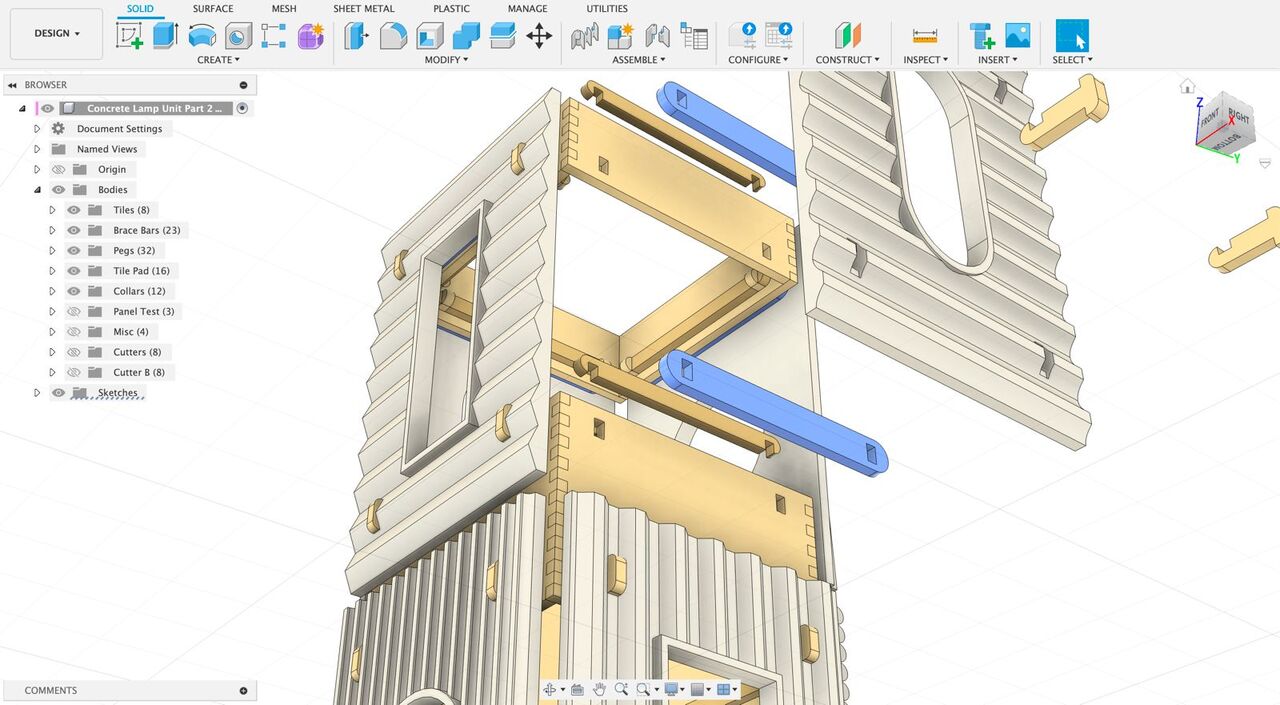
An object takes shape on a laptop. On screen, version 34 of a tower of tiled faces sits inside Fusion’s grid – arched cut-outs and pegged corners, neatly parameterised, rules not guesses, the model promising a clean translation from geometry to matter. A small banner marks the platform’s personal tier, quiet limits on export and tolerance analysis pushing diagnosis back into hand-and-eye. Fusion 360 holds tolerances; Illustrator only shapes; Blender’s CAD plug-in adds an interface to an interface – each tool in the chain a different template, with its own latency and error signals.
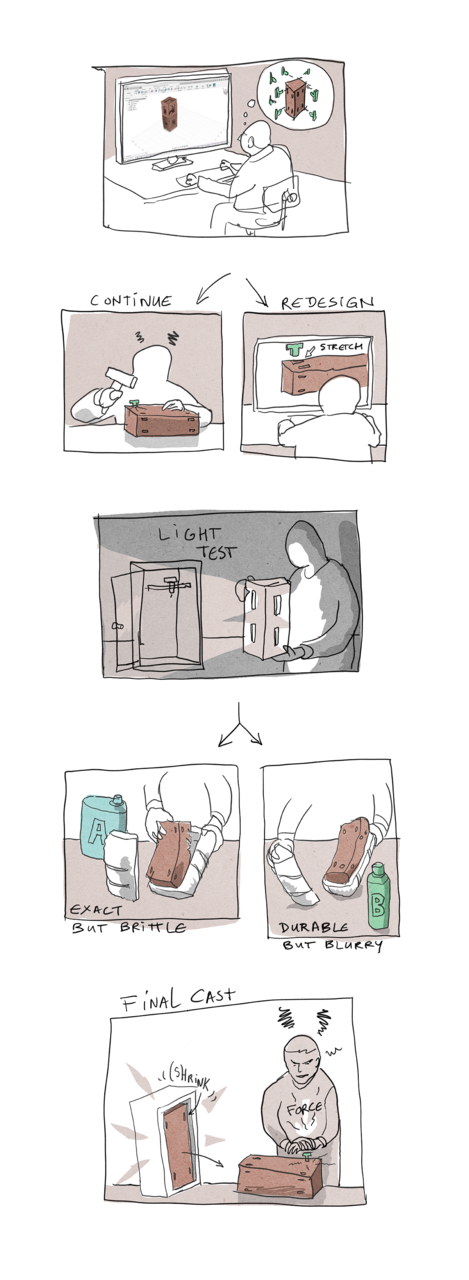
On the bench, a laser-cut acrylic mock-up goes together until the pegs bite; the tolerance is unexpectedly tight – a dry scrape and slight warp at the hole edge announcing interference the model didn’t predict. Don’t force the fit.
A fast Bambu print (“the air fryer of 3D printing”) becomes the master to audition light and shadow before the pour; print resolution and machine tolerances set how much slack the fit needs. Two silicones sit on the shelf – one for crisp edges, another for easy release – and the choice will decide whether a tile survives demoulding or sheds a corner when nudged out. The eventual cast will shrink a touch, opening holes. Today’s bite could turn slack in concrete or jesmonite, so version 35 adds a little clearance and a note on cure.
Advice arrives as soft protocol – studio lore and forum threads – while the hard files carry the change.
This text trades “masters” for distributed, scaffolded mastery: windows, budgets, edit rights designed so errors can still teach. Not an inventory of endangered crafts, not a romance of lost wisdom.
While reading, watch for correction windows – the gaps where error becomes instruction.
Reading revision
In software development, a ‘diff’ shows what changed between versions – the corrections, additions, deletions that transform version 34 into version 35. But craft knowledge lives in the capacity to make changes, not their record. Read craft not as fixed tradition but as continuous revision, each correction a negotiation with material resistance. Heritage programmes count practitioners and preserved techniques. They neglect the correction windows that support mastery: sacrificial stock, mentoring rhythms, revision time. The question cuts deeper than preservation: what lets errors teach?
One way in: look for the nouns – templates, files, protocols, the things that travel. Look for the verbs – sensing, correcting, revising, attending. Then ask who maintains the envelope – the time, slack, and scaffolding that keeps correction possible.
A portable grammar
This grammar is meant to travel. Four variables, four moving parts:
| Definition | Function | Micro-examples | |
 Resistance-cue Resistance-cue
|
The moment matter “talks back” – a deviation in sound, force, timing, or computation, initiating attention and adjustment. | Triggers the correction loop | Torque spikes, pitch shifts, grain tears, sudden heat bloom |
 Correction window Correction window
|
The interval in which intervention can turn error into instruction, before wrongness hardens into reworking or a loss of control. | Bounds feasible adjustment | Two seconds before wobble sets |
 Template-device Template-device
|
A theory-bearing artifact that predicts fit and regulates error, condensing conjecture, method, and memory into actionable guidance. | Carries a change from signal to action across hands and contexts | Zinc curve, slicer profile |
 Attention scaffold Attention scaffold
|
The social and infrastructural supports that distribute the work of noticing and recovery, keeping cues legible and windows open | Keeps learning loops open | Quiet room, spare stock, mentor time, peer feedback, public diff archive |
Different resistances (sound, force, computation) open correction windows, each cultivating distinct attentional capacities; read a practice by the windows it keeps open and why.
Template-devices as theory-bearing media
This is the hinge: when practice meets resistance, templates carry a theory of fit that keeps correction teachable. Cathedral construction meant building through experiment – arches and buttresses tested builders’ intuition in public, precision relocated into materially manifest guides that could circulate as rule and ratio. In the absence of formal mechanics, medieval templates made stability possible. In his book Masons, Tricksters and Cartographers, David Turnbull identified templates as having ‘the power of a scientific theory’, integrating practice and knowledge. This text follows this power beyond the cathedral walls.
A template-device is a theory of fit: an arrangement of material tools and shared signals that condenses conjecture, method, memory into guidance with error expectations. It turns resistance into actionable adjustments across hands and sites. In flintknapping, a clean flake is a local theory of fracture rehearsed in the wrist. Experimental archaeology shows this knowledge is remade through making and breaking Adrian Currie, ‘Speculation made material: Experimental archaeology and maker’s knowledge.’ ; templates ‘switch on’ when resistance exceeds what unaided gesture can manage.
Open-source hardware exposes a split between devices and envelopes: platform libraries move designs at internet speed; the bench obeys material time, where each tweak waits on heat, cure and the next print cycle. First-run parts often speak back: a rattling “chatter” as the frame resonates, fuzzy edges where layers don’t quite press together, glossy ridges that echo a change in direction, or fat, bulging corners (“elephant’s foot”) when the first layer runs too hot or too slow. These signals suggest specific moves: add clearance, slow the head, drop the bed a notch, re-level and re-run. Two or three sacrificial prints buy a window to adjust heat, cooling, and speed. What’s needed isn’t just a file, but slack – time, scrap, permission to iterate – so revision and recovery can be held open over distance. Clay proved this during COVID-19 lockdowns. The wobble before collapse gives seconds to adjust; peer feedback via social media arrives hours too late. New learners were still able to develop their knowledge through material feedback, but tutorial videos travelled without their correction windows. See: Catherine O’Brien, ‘COVID, clay, and the digital.’
Templates circulate while their activating conditions – the maintained capacity to read resistance – must be reconstructed on site. The device is portable; the envelope is not. Perfect files and flawless videos arrive incomplete, awaiting reconstruction of the scaffolds that let errors teach.
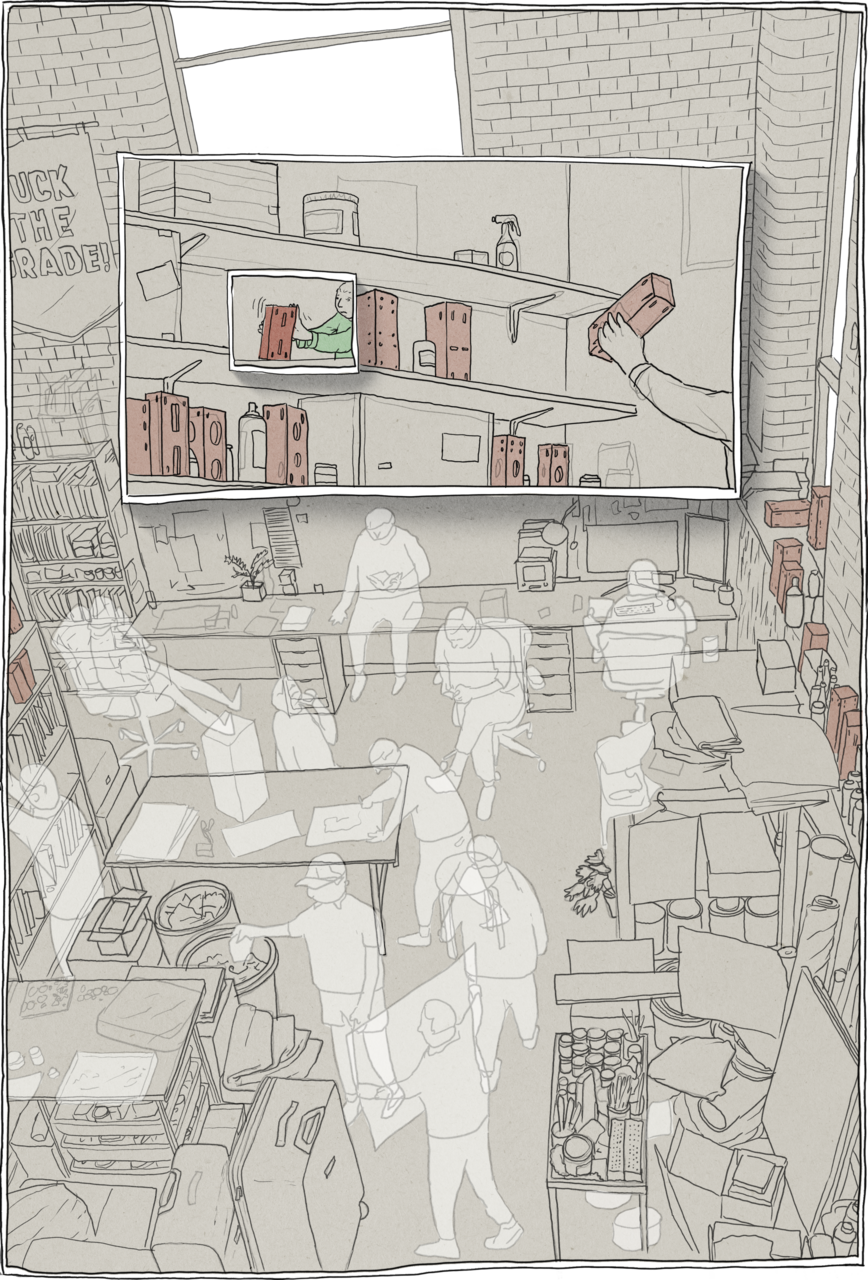
Maintaining the envelope
Different media attempt different solutions. In Japan’s Master of Restoration, a documentary series following ceramic conservator Koji Mayuyama and his son Yu as they restore museum and private pieces, the camera lingers on tactile micro-moves – test-fits, pigment-mixing, feathered in-painting. But the edit compresses: time cards collapse days of solvent dwell and lacquer curing into seconds. Months of layered pigment application become minutes of screen time. The knowledge carried in the body (including, in Mayuyama’s case, a finger sanded smooth for lacquer handling) resists representation in narrative media, without compression into plot points. Such compression serves narrative, but would shatter actual practice.
Try this: Watch any craft tutorial or repair video at 0.5x speed. Count the cuts. Each cut removes a window where correction could become instruction. Look for what stops being teachable.
Variations
York Minster’s tracing floor, an Alpine dairy, a rented New Jersey warehouse. Three practices, separated by continents and centuries. Same grammar, different tempos.
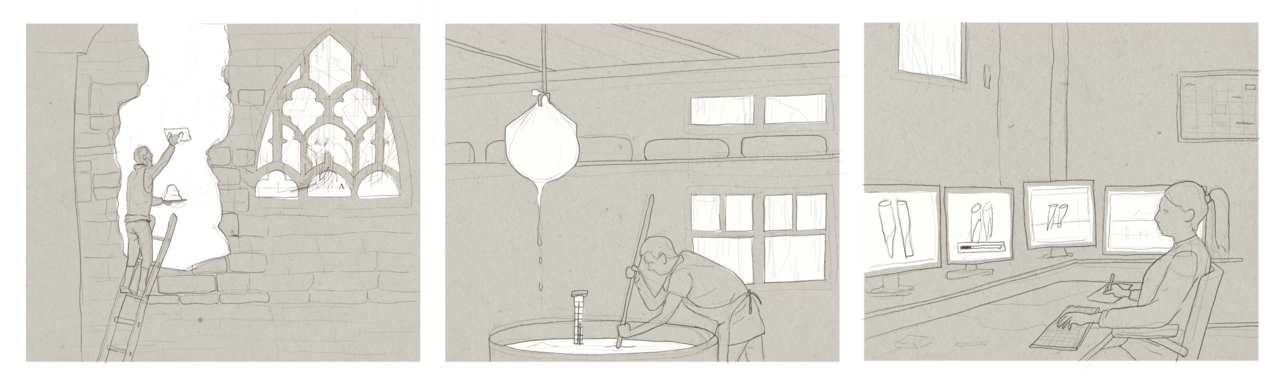
In York Minster’s masons’ loft, thin plaster layers mark a paradox. Stone’s permanence emerged from lines on plaster – not the direct template-cutting once assumed, but a protected room for iterative setting-out.
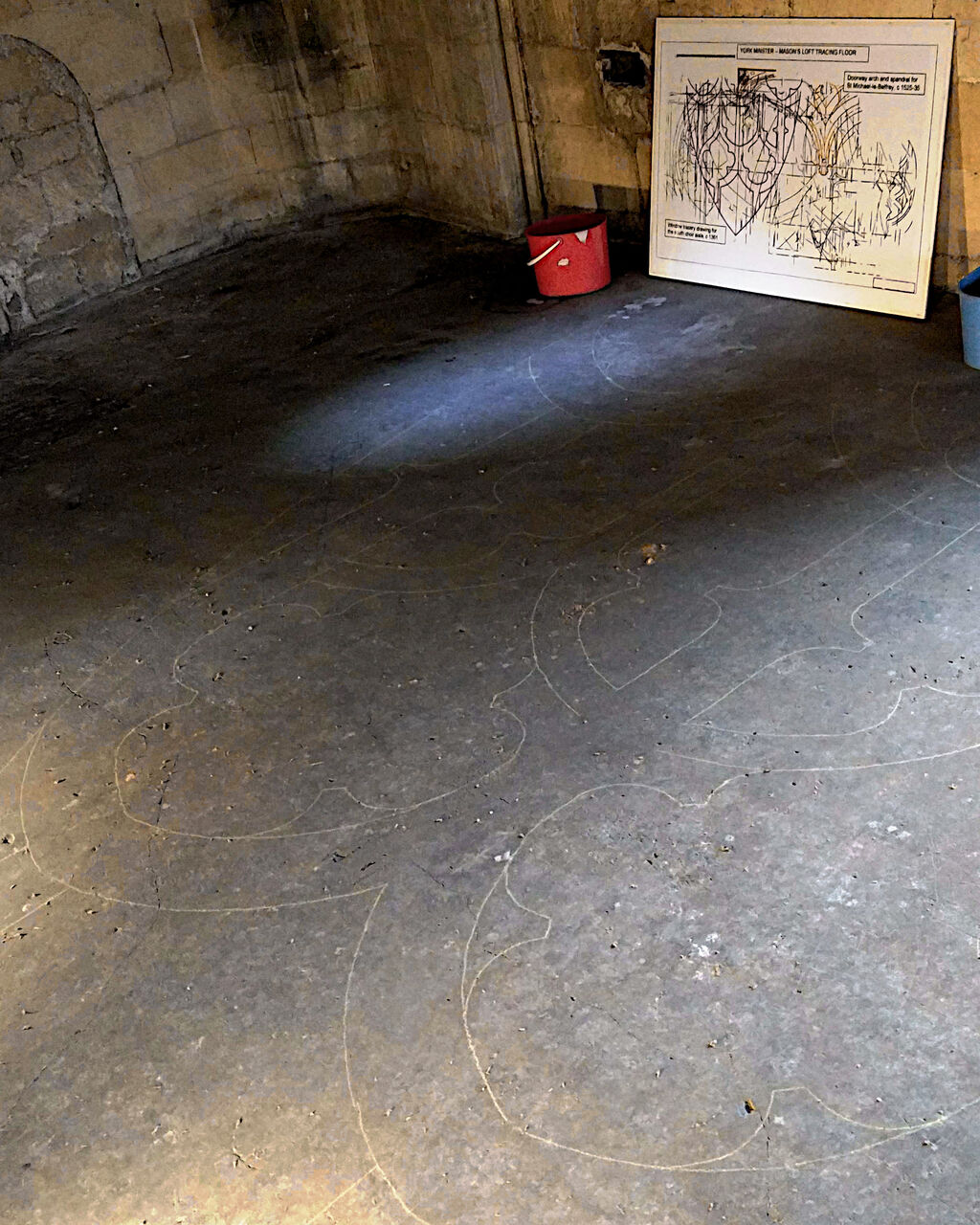 Masons’ loft, York Minster
Set above the chapter-house vestibule, the loft’s floor was laid in thin plaster layers over vault fill, re-plastered and incised across seasons. Forms were tested, erased, and redrawn, until the line was ready to commit to ashlar. With light, heat, and privacy, the loft scaffolded winter-season design work. The floor worked as a 1:1 hypothesis engine, proportions proposed, sensed underfoot, then exported as workable rules. Line on plaster became a portable instruction for stone, team, and schedule, with the room itself keeping the correction window open. Without the loft's protection – had budget or schedule forced the line straight to stone – the envelope would have collapsed, and the error hardened. Composite example after Lon R. Shelby’s ‘Mediaeval Masons’ Templates’, Alexander Holton’s ‘The Working Space of the Medieval Master Mason’, and Jennifer Smith’s ‘Medieval Masons and Tracing Floors.’
But what happens when the window shrinks from seasons to hours? In the alpine dairy, the bacteria set the tempo: doubling on their own clock, they drop pH whether or not anyone is ready. A low scald ripens fast. Soft wheels and a quick rind prompt adjustment. The window spans minutes at the vat and days on the shelves, offering nested chances to revise before a room overruns its envelope. Consultant visits and state lab cultures scaffold judgement without black-boxing it. Attune: read texture and aroma. Nudge heat and fat. Let the next batch confirm or surprise. Example after Matthäus Rest, ‘Oimros: Notes on a Summer Alpine Journey.’
And when the material is digital? In a rented New Jersey warehouse, constraint becomes method as a small team holds a world in one room. They frame mid-shots to keep the ground out Foot-to-ground contact is one of the hardest, most costly things to fake on a tiny VFX budget. , layering a painted city so flat images read as depth. The template is a shared shot recipe – low horizon, layered cards, limited palette – motion tracking anchors the illusion. Cues arrive as compile/render delays. Short loops inside a shot – test a projection, nudge controls, rebalance light – before the look bakes. Longer loops span months of render queues and incremental GPU upgrades. When a shot demands more depth than layers can provide, the method evolves: paint first, project onto simple shapes, add a subtle height map for micro-relief. Tutorials and kitbash assets Kitbashing = assembling worlds from pre-made parts scaffold iteration; the world holds because the recipe keeps learning. Example after Nicolas Ashe Bateman’s work on The Wanting Mare.
video: https://youtu.be/4h7yZX50XC4
Three materials, three timescales, three models of envelope control. This table maps what differs – where cues arise and how long the correction window stays open:
| York Minster tracing floor | Alpine cheese-making | Indie VFX/SFX | |
|
Resistance-cue |
Overlapping, incomplete tracery and stratified plaster that resist direct transfer; access / logistics opposing on-floor cutting | Too-low scald; soft wheels; unstable rind; pH shift signalling fat / acid imbalance | Untrackable lens distortion; files too heavy; water lacking depth; tool updates breaking yesterday’s fix |
|
Correction window |
Erase-redraw cycles of sacrificial plaster before committing to ashlar | Minutes at vat, days on shelves to adjust cut, heat, or fat | Minutes per test render; hours per shot iteration; months for a full sequence – each loop nested within the next |
|
Template-device |
1:1 settings-out; square-in-square geometry, pins and string; ratios exported as rules | Recipe-as-protocol (4-hour make, 12 month age cycle); daily pH curves; seasonal milk variation patterns | Frugal shot recipe (low horizon, layered cards, limited palette); paint-then-project with subtle height maps |
|
Attention scaffold |
Protected upper room off-cycle from site work; winter drawing seasons; institutional patience for erasure / redraw cycles; sacrificial plaster budget | Cheesemaker’s dawn adjustments; travelling consultant’s seasonal visits; state lab as microbial anchor; sacrificial test wheels; peer knowledge at markets | Cinematography and lighting assistance embedded through post-production; late-night paint-overs; render queue time-sharing; video tutorials and kitbash assets |
| Temporal rhythm | Seasonal cycles, winter drawing time | 20-minute bacterial doubling, daily rounds, seasonal production | Shot iterations, render queues, 5-year production arc |
Stone teaches patience, microbes demand attunement, pixels enforce iteration. Different resistances, but the grammar holds: catch the cue, deploy the template, keep the correction window open long enough to learn.
Same grammar, your practice. Where are the resistance-cues? The correction windows? The template-devices? The attention scaffolds?
From mastery to maintained revision
Version 34 becomes version 35 through maintained conditions for revision, not genius or a transformative breakthrough. What changed matters less than who maintained the capacity to change it. This distinction cuts deep.
“Innovation” is the annealed residue of many negotiated corrections. Read its strata in the shelf of test wheels, years of render logs, chalk notation on a tracing floor. Each correction requires someone to hold the window open. The medieval masons’ ratios worked because someone protected the upper room for seasonal erasure. The cheesemaker’s recipe works because someone funds the test wheels. The VFX grammar evolves through five years of nights and weekends. Each practice encodes its own temporal sovereignty – the right to learn at the speed of bacteria, stone, or render queues.
The question isn’t who owns the templates but who maintains the conditions for their revision. When quarterly audits compress winter drawing seasons, when render farm quotas foreclose iteration, when subscription tiers ration the renders a correction needs – whose knowledge becomes unthinkable? Make the maintenance visible: not just what changed, but who could afford to hold the window open while they learned.
Who can edit this template? What breaks if they can’t?
Illustrations by Theun Karelse; the opening vignette draws on conversations, visits, and studio observations with Paul Hallows.
🜛